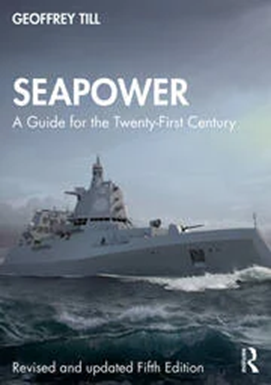
Seapower: A Guide for the Twenty-First Century

This is the 5th, revised and updated, edition of Seapower: A Guide for the Twenty-First Century.

The sea has always provided the basis for mankind’s prosperity and security. With the emergence of an increasingly globalised world trading system in the early part of the 21st century, this became ever more obvious. Contemporary conditions have therefore required navies to adapt and to expand the range of their interests, activities and responsibilities. The Houthi assault on international shipping in the Red Sea and the need to monitor sanctions and ‘dark fleet’ operations shows that these tasks are important and developing fast. Even so, and especially with the re-emergence of potentially de-stabilising great power competition, traditional hard power naval concerns still predominate. This book investigates the consequences of all this for the developing nature, composition and functions of the world’s navies, and provides a guide for the changing but crucial role of seapower in the second quarter of the 21st century. This edition contains new material on the Russo-Ukraine and Gaza wars, tensions in the Indo-Pacific, the Arctic and North Atlantic, the emerging concept of ‘seabed control,’ as well as the extent that technological innovations and other recent strategic developments are challenging traditional concepts of maritime strategy and the roles of navies.

This book is essential reading for students and practitioners of naval power, maritime security and naval history, and highly recommended for students of strategic studies, international security and International Relations.


Read More
Keeping Friends Close and Enemies Closer: Praxis in International Security Order and the Singapore Armed Forces

That multilateral or joint military exercises are seldom studied is puzzling given that they can be a more overt manifestation of international relations than diplomacy or international organizations. This article addresses this gap in International Relations theory and praxis by examining how the two typical explanations of joint military exercises, deterrence and defence diplomacy, may reflect or build a realist or liberal international order, defined as the stability and organization of relations between states. We argue that we cannot easily distinguish between the deterrence and defence diplomacy purposes of joint military exercises simply via material indicators in terms of the scale and type of the exercise. Instead, they are two sides of the same coin such that joint military exercises are what states make of them, following a constructivist explanation. We demonstrate our arguments using a case study of Singapore and its military exercises with Malaysia, and with the United States.

Read more
How Indonesia and Vietnam navigate coalitional networks in the Indo-Pacific

This article explores how two Southeast Asian middle powers, Indonesia and Vietnam, have responded to U.S. and China-led efforts to build coalitional hegemonies in the Indo-Pacific. Through the lens of network analysis, the article argues that while Indonesia and Vietnam have sought to enhance their positions in the coalitional networks that are being established by China and the United States, neither Jakarta nor Hanoi wants to be embedded exclusively in either network. The analysis here contributes to the discussion on middle powers and networks—especially in the context of competing networks—as well as to the existing literature regarding Southeast Asian responses to China-U.S. rivalry.

Read More
The Liberal Conundrum: Sino-American Conceptions of Liberalism in Domestic-International Affairs

This article examines how liberalism—as a set of ideas governing normative conduct in international affairs—and how Sino-American concepts of liberalism are being understood. Given that liberal scholarship is traditionally associated with values of open internationalism, globalization and free-market principles, it is generally believed that a greater affinity with liberal principles would generate positive relations between China and the rest of the world. This has not happened, particularly in the realm of Sino-US relations. This article contends that at the heart of the tensions and misunderstandings between China and America lies how liberalism is being defined and understood. By looking at the idea of the “separation of powers” and “multilateralism and the rules-based order,” this article seeks to unpack what liberalism means for Beijing and Washington. It argues that while liberalism in the West represents a universal call to remake the world in the West’s idealized image, liberalism in China is defined within domestic conditions so as to remake China in an idealized world image.

Read More
Ponder the path of thy feet: How China’s security–development nexus works in the Mekong region

This article explores China’s evolving approach to South–South security cooperation, focusing on its use of the security–development nexus in its relations with Global South countries, particularly in the Mekong region. The central research question is: under what circumstances will China adjust the balance between security and development in its cooperation with the Global South? The study also offers insights into the challenges China faces in managing its dual role as both a development partner and a security actor, with implications for its influence in the Mekong region and beyond.

Read more
Latest Publications
AUTHORED/EDITED BOOKS
What We Read, and Why
Read more
BULLETINS & NEWSLETTERS
Think Tank 2026
Read more
Subscriptions
Stay up to date with our online publications and event invitations.
Upcoming Events
RSIS Webinar by Mr Ibrahim Suffian
Johor Decides: Electoral Dynamics and National Implications
06 JUL 2026
10:30 - 11:45
Public
ZOOM
Register
RSIS Seminar by Mr Thu Htet
Are Southeast Asian States Hedging against Great Power Competition? How Regional States Conceive the International Order and its Implications for Understanding Hedging
07 JUL 2026
15:00 - 16:30
Public
The Keypoint, RSIS
20-24 JUL 2026
5 Days
By Invitation
Changi C2 Centre
4th Digital Defence Symposium (DDS 2026)
Building Digital and Information Resilience: Technology, Norms, and the Cyber Information Continuum
21-22 JUL 2026
2 Days
By Invitation